 |
| Seriously, go check it out. It has pictures. |
Tuesday, May 10, 2011
I've Been Working on the Railroad
Just to pass the time away, of course. Anyway, I reserve the right to use Engineer in Progress to ruminate on ideas I like, and last night I saw a really interesting one. Ray MacVay, from Blue Max Studios (makers of the hard-scifi RPG Tales of the Black Desert), made an interesting post entitled Artificial Gravity and What Rollercoasters Can Teach Us, and it solidly engaged what someone of my acquittance once called my "turbonerd" mode. The proposal is to use self-propelled train-like cars moving around a fixed circular rail for large spin-gravity spacecraft, instead of a large rotating structure. I'm not really explaining it well, and he does a much better job, so...go read the original post. I'll wait.
Done? All right, let's talk the engineering of such a system. First of all, I like a lot about it. Air doesn't need to cross the spin division because entire cars do, presumably each with on-board life support, water reprocessing, and that stuff. Power and data are a bit trickier--unless the cars have their own on-board power generation, then electrical power will still have to be sent to the cars with slip rings, and data will have to be sent from car to car either with a wireless network or (if wired is preferred) another slip ring setup. Still, it's an interesting modular system. Still, there's one or two things that need work.

Monday, May 2, 2011
Not-So-Shiny Metal
Well, the J2X blog has been having some amazing posts and images of their progress in readying the first J2X engine unit for testing, with both the engine and the test stand stand getting close to ready. Hopefully, things will continue to go well, and we might soon see this engine fire, the first good-sized hydrogen/oxygen engine (important for upper stages) to be developed in the US in quite some time.
 |
| J2X engine unit under assembly |
 |
| Test stand A2, with J2X mass simulator in place |
I'm not sold on the need for the J2X or some of the proposed applications. I've heard some arguments for it, I've heard some against, and none have completely convinced me. Still, it's really exciting getting the inside look at the development process that the J2X blog has been offering. The J2X is a modification of the J2, originally developed as the upper stage engine to send the Apollo missions to the moon. However, since changes have taken place in manufacturing techniques and theory in the days since the Apollo program and the J2 has been out of production for almost 35 years, the J2X is less of a modification of an old design and more a new engine that uses the same basic design. One example of this inspired the title of this post, the Shiny Metal post about exploring making use of additive manufacturing techniques to speed up construction and lower costs.
So...what does this all have to with me? Why post about it on Engineer in Progress? Well, it's cool new stuff in aerospace, and I like talking about that. However, it also reminds me of something that I've been working on with the University of Dayton Advanced Rocketry Team (UDART). I've been getting into the organization this year, and the last few days we've been doing some work on our own engine. If you look at my profile picture up on the top right, you'll see me holding the club's LR-101 rocket motor, taken at a presentation they did early in the year before I got involved (actually, that presentation was part of how I ended up getting involved, but that's not worth talking about).

The LR-101 is a liquid rocket engine that burns kerosene and liquid oxygen, and produces about 1,000 lbs of thrust. Just like J2X, the LR-101 has a rich history--while the J2 was developed as an upper stage engine for Apollo, the LR-101 was intended as a vernier steering motor for the Atlas missile--note the welded patches on the combustion chamber where the old gimbal system used to attach (see the image below for what an LR-101 looks like with that).
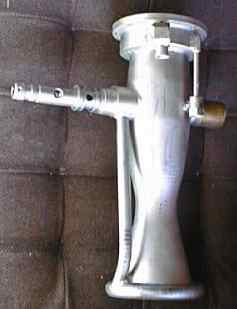
However, while the J2X is under development and testing to qualify new modifications, we want to test this engine to ensure it's still got enough of the old performance left for the application we'd like to use it in--as the main engine of a sounding rocket intended to reach up to 30,000 feet. To do this, we need to put the engine on a test stand, instrument the engine, and static fire it. The mount at the bottom of the engine in the picture above is part of the mount to the stand. Since I've been a bigger part of the team, I've made getting the test stand ready a priority of mine, and the last few weeks as I've had time away from Aerodesign have paid off handsomely.
 |
| UDART LR-101 test stand. Click Image for full size |
The entire frame is designed so that we can load it into a pickup truck and move it to a site where we can actually fire the engine, as opposed to our lab next to Five Guys and Panera on Brown Street. At the site, we can then tie it down securely, but the main engine connections and others don't require further work at the site beyond verifying functionality. The way the system works is diagrammed below.
 |
| Digram of Propellant Systems |
There are three tanks, one of the kerosene fuel, one of the oxygen, and one of high-pressure nitrogen. The nitrogen serves to pressurize the main tanks and force the reactants (the kerosene and oxygen) into the engine to be reacted. To fire the engine, we first open the pressurization valve to bring the tanks to pressure, then open the propellant valves and ignite the engine. The actuators for the valve assemblies can be seen above, though the ball valves themselves are sort of hiding behind the engine mounting plate. A better view of this section can be seen below.
 |
| Test stand from upstream. The valve assembly is at the bottom center of the photo. |
The valves we use are ball valves, and to ensure proper operation, we have to make sure that the actuator moves them from completely closed to completely open, but doesn't try to go beyond these limits (to avoid deflection of the frame). To do this, we first adjusted the fitting between the actuator rod and the valve rotation link so that it is in the fully closed position when the rod is fully extended, then checked how long the rod needed to be when the valves were fully open. To stop the rod from getting any shorter than this, we have to insert a stopper, shown below.
 |
| Spacer/Stopper Rod, Checking Length After Cutting |
This consists of a cylindrical piece of metal that goes around the actuator rod. When the rod retracts to the length we want to be the minimum (and corresponding to fully-open valves), the stopper will be stuck between the actuator cylinder and the fitting on the end of the rod, preventing any further retraction. To make this, we took a piece of metal stock that had the right outer diameter, and machined it to have the proper internal diameter. However, while the stock we had did have a hole in it, it was not only too small for the actuation rod to fit through, but in fact too small for the smallest boring bar we had for the lathe to fit into.
 |
| Original stock center hole size |
 |
| Required final inner diameter |
Thus, what we had to do was first drill out the center hole with a drill bit, then further increase the internal diameter with the boring bar until the internal hole was large enough to fit around the rod. However, there was one last issue--the boring bar was too short to fit all the way through the stopper size we needed. When we realized this, we had already spent several hours messing with the stand Saturday, so we decided to call it a night instead of taking the time to do the ten or so cuts it would take to do the other side.Thus, tomorrow, we have to turn the stopper around, and finish boring out the last few centimeters of the other side Actually, the images taken above are of the two ends of the same piece that will become the stopper, so you can see clearly what we have to do. Still, once this is done, we will be able to finalize the actuators, assemble the plumbing to the tanks, and leak test and check the entire system. Then, we just have to take the whole thing apart and clean it to be ready to test. The whole thing is a lot closer to operational than it used to be, and I can't wait to see the job through to static firing.
Friday, April 29, 2011
Shooting Gumballs
So, this is a recycle in a way. In the dim and distant past before I had a blog (read: last summer), a friend and I spent an interesting afternoon working out the answer to a scenario we came up with, and I thought it was fun, so I'm posting it here at Engineer in Progress. Let's say NASA and commercial comes through, the whole shebang. 4 commercial crew vehicles funded to completion by CCDEV (SpaceX Dragon, Boeing CST-100, SNC Dreamchaser, and Blue Origin's....thing). Between NASA and commercial, 4 man-rated US launchers (SLS, Atlas V, Falcon 9, Falcon Heavy). ISS is fully utilized, Bigelow gets things going on a commercial station, Astrobotic goes to the moon and wins the Google Lunar X-Prize (or some other comparable team does).
But you don't work for any of those companies. You don't build launchers, or capsules, or stations, or unmanned landers. You work for Space Supply Corp, Inc, Ltd and your division is bidding on a vending machine contract. Specifically, you're bidding to refill these critical pieces of equipment:
 That is, gumball vending machines. Well, a version of them that doesn't use gravity feed. This isn't 2001, we don't have artificial gravity! This is near-term gumball-machine resupply contracting, after all. So...how much does an astronaut need to feed in to get out his gumball? Glad you asked!
The first question is shipment method. The average 1" gumball consists of a spherical shell about 1/8" thick, surrounding a central cavity that is approximately atmospheric pressure. This central cavity poses a problem: on the ground, the gumball does not experience a significant net pressure across the shell, since the air inside and outside are pretty similar (off by maybe a few kPa depending on the weather and the altitude of the ambient conditions of manufacture and measurement). In orbit, though, the gumball center has a full atmosphere inside, and a vacuum outside. Thus, it's acting like a pressure vessel, with the pressure inside being like being 30 feet underwater. If the gumball shell is not capable of taking the stresses of this, then the shell will fail, and either simply rupture or pop like popcorn (hence the highly technical term "popcorning"). The Space Shuttle External Tank's anti-ice insulation (which is made up of similar closed cells of foam) would do the same after time in space, which is why no studies for a Skylab-style wet lab were ever really considered seriously--huge risk for orbital debris.
So, if the gumballs aren't strong enough, they pop. How do you know if they are? Engineering! The material stresses on a spherical thin-walled pressure vessel are as below.

Sigma (the o with the line on the left) is the stress on the material. If this exceeds the maximum material properties of un-chewed gumball (chewed gum is over course deformable, which would change things in ways I'm not entirely trained to handle at the moment, but thankfully Space Supply Corp. Inc. Ltd does not supply NASA with ABC gum), the shell will break. In the equations, p is the pressure, so here it's 101 kPA (atmospheric in kiloPascals, the metric unit for pressure). The t is thickness, and the radius is r. Keep these units consistent, and they'll cancel out leaving just a ratio. (For the record, the radius-to-thickness ratio for 1" gumballs is slightly too large for the thin-wall approximation according to rules of thumb. It's 4:1, when 10:1 is supposed to be the max. But you get free engineering secrets for gumball shipment, you take my baseless assumptions.).
Calculating, the material stress is 404 kPa. So...does the gumball pop? Unfortunately, I can't find any research on the material properties of unchewed gum (attention scientists!), but this is a required strength something like 1/2th the minimum strength of rubber, so I feel confident in saying it has a good chance of working. This is nice, it means you don't need to use precious volume inside a pressurized transport like Dragon, Cygnus, CST-100, Soyuz, Progress, whatever, you just ship up your gumballs in a bag in Dragon's trunk, or the HTV external pallet bay, or something like that. You'll need an astronaut to grab it with a robot arm or snag it on an EVA to bring it in, but hey, it works.
So, now we have the shipping requirements (unpressurized transport, some minor details on receiving). What's the cost? The current Falcon 9 carries 10.5 tons to orbit, but the version coming with the Merlin 1D upgrade is supposed to increase that to about 16 tons. Both are to cost about $56 million. This is a price of either $5,333 per kg or $3500. Wikipedia says Russia's Proton costs about $4400/kg. I'm not running numbers for the Atlas V or Delta IV, I can tell they will be worse since they cost more than Falcon by a factor of 4 or more for similar base payloads, and the pricing doesn't get better for Heavy versions. Falcon Heavy, on that note, is supposed to get down to $2200/kg.
So, what does this all mean for our gumballs? A 16 lb bag of 1" gumballs on Amazon costs roughly $30 (though the actual specs at the bottom say 17 lbs...odd), and contains 850 balls. Thus, each masses about 8.75 grams. Since the bag comes included in this mass and gumballs are probably vacuum-rated, there's no further shipping mass. So, cost to fly is easy if you completely ignore any cost-sharing or free-rides with other customers: Multiply the per-kg launch cost by the mass in kg of one gumball, and find the cost to user on orbit. For Falcon 9 currently, this would be $46.66, or $30.63 on the Merlin 1D variant that's supposedly coming soon. The Russian Proton workhorse would cost you $37.6 dollars per gumball, while the Space Shuttle is in the range of $291.67 per ball. Falcon Heavy's goal price would see a gumball representing a cost of $19.25. However, while the astronaut is carefully feeding those 77 quarters into the little slot and cranking the handle, note the shipping markup: the cost to Space Supply Corp, Inc, Ltd is only $30 a bag for 850, or about 3.5 cents per gumball, or a shipping and handling markup of about 5400%. For the record, this also means that the 25 cent gumballs you see so often are selling for a retail markup of 200%.
However, the gumball isn't a great metric for spacecraft themselves, just an example of the costs of shipping even a relatively tiny but imaginable payload--this same economics applies to every T-shirt, can of tuna, and bag of wet-wipes sent to the ISS crew and any potential future space exploration. Cheap to supply, expensive to ship. Spacecraft are a bit different, since even a small spacecraft (a bit heavier than a backpack with a few engineering texts in it) might contain several million dollars of specialized components, plus the spreading out of the cost of integration, testing, design and development before selection of a final design....it's easy for me to design something like this costing $10 million that costs no more than $50,000 to launch to orbit where spacecraft cost is only half a percent of total cost. However, any base needs some kind of supplies, and these will include a large portion of the cheap-to-buy, expensive-to-ship variety I mentioned. ISS uses a good amount of food and water, and when HTV-2 burned up on return from the ISS earlier this year, a large part of the trash it carried was foam that had ridden to orbit wrapped around science experiments.
As a final exercise for the reader, the Google Lunar X-Prize team Astrobotic has a publicly posted payload planning guide that says a base price of $1.8 million per kg. Find the cost of a gumball delivered to the lunar surface. Highlight for answer: $15,700 or so. A lunar gumball costs about the same as four tons of supply-cost gumballs, 62.8 thousand Earth gumballs, or about 424 orbital gumballs.
But you don't work for any of those companies. You don't build launchers, or capsules, or stations, or unmanned landers. You work for Space Supply Corp, Inc, Ltd and your division is bidding on a vending machine contract. Specifically, you're bidding to refill these critical pieces of equipment:

The first question is shipment method. The average 1" gumball consists of a spherical shell about 1/8" thick, surrounding a central cavity that is approximately atmospheric pressure. This central cavity poses a problem: on the ground, the gumball does not experience a significant net pressure across the shell, since the air inside and outside are pretty similar (off by maybe a few kPa depending on the weather and the altitude of the ambient conditions of manufacture and measurement). In orbit, though, the gumball center has a full atmosphere inside, and a vacuum outside. Thus, it's acting like a pressure vessel, with the pressure inside being like being 30 feet underwater. If the gumball shell is not capable of taking the stresses of this, then the shell will fail, and either simply rupture or pop like popcorn (hence the highly technical term "popcorning"). The Space Shuttle External Tank's anti-ice insulation (which is made up of similar closed cells of foam) would do the same after time in space, which is why no studies for a Skylab-style wet lab were ever really considered seriously--huge risk for orbital debris.
So, if the gumballs aren't strong enough, they pop. How do you know if they are? Engineering! The material stresses on a spherical thin-walled pressure vessel are as below.
Sigma (the o with the line on the left) is the stress on the material. If this exceeds the maximum material properties of un-chewed gumball (chewed gum is over course deformable, which would change things in ways I'm not entirely trained to handle at the moment, but thankfully Space Supply Corp. Inc. Ltd does not supply NASA with ABC gum), the shell will break. In the equations, p is the pressure, so here it's 101 kPA (atmospheric in kiloPascals, the metric unit for pressure). The t is thickness, and the radius is r. Keep these units consistent, and they'll cancel out leaving just a ratio. (For the record, the radius-to-thickness ratio for 1" gumballs is slightly too large for the thin-wall approximation according to rules of thumb. It's 4:1, when 10:1 is supposed to be the max. But you get free engineering secrets for gumball shipment, you take my baseless assumptions.).
Calculating, the material stress is 404 kPa. So...does the gumball pop? Unfortunately, I can't find any research on the material properties of unchewed gum (attention scientists!), but this is a required strength something like 1/2th the minimum strength of rubber, so I feel confident in saying it has a good chance of working. This is nice, it means you don't need to use precious volume inside a pressurized transport like Dragon, Cygnus, CST-100, Soyuz, Progress, whatever, you just ship up your gumballs in a bag in Dragon's trunk, or the HTV external pallet bay, or something like that. You'll need an astronaut to grab it with a robot arm or snag it on an EVA to bring it in, but hey, it works.
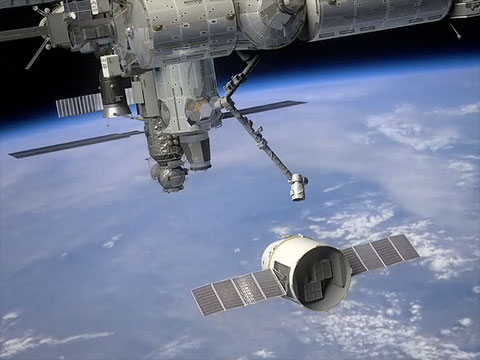 |
| SpaceX Dragon Approaching ISS Unpressurized cargo like gumballs can go inside the cylindrical trunk section. |
So, what does this all mean for our gumballs? A 16 lb bag of 1" gumballs on Amazon costs roughly $30 (though the actual specs at the bottom say 17 lbs...odd), and contains 850 balls. Thus, each masses about 8.75 grams. Since the bag comes included in this mass and gumballs are probably vacuum-rated, there's no further shipping mass. So, cost to fly is easy if you completely ignore any cost-sharing or free-rides with other customers: Multiply the per-kg launch cost by the mass in kg of one gumball, and find the cost to user on orbit. For Falcon 9 currently, this would be $46.66, or $30.63 on the Merlin 1D variant that's supposedly coming soon. The Russian Proton workhorse would cost you $37.6 dollars per gumball, while the Space Shuttle is in the range of $291.67 per ball. Falcon Heavy's goal price would see a gumball representing a cost of $19.25. However, while the astronaut is carefully feeding those 77 quarters into the little slot and cranking the handle, note the shipping markup: the cost to Space Supply Corp, Inc, Ltd is only $30 a bag for 850, or about 3.5 cents per gumball, or a shipping and handling markup of about 5400%. For the record, this also means that the 25 cent gumballs you see so often are selling for a retail markup of 200%.
However, the gumball isn't a great metric for spacecraft themselves, just an example of the costs of shipping even a relatively tiny but imaginable payload--this same economics applies to every T-shirt, can of tuna, and bag of wet-wipes sent to the ISS crew and any potential future space exploration. Cheap to supply, expensive to ship. Spacecraft are a bit different, since even a small spacecraft (a bit heavier than a backpack with a few engineering texts in it) might contain several million dollars of specialized components, plus the spreading out of the cost of integration, testing, design and development before selection of a final design....it's easy for me to design something like this costing $10 million that costs no more than $50,000 to launch to orbit where spacecraft cost is only half a percent of total cost. However, any base needs some kind of supplies, and these will include a large portion of the cheap-to-buy, expensive-to-ship variety I mentioned. ISS uses a good amount of food and water, and when HTV-2 burned up on return from the ISS earlier this year, a large part of the trash it carried was foam that had ridden to orbit wrapped around science experiments.
 |
| Astrobotic Lander 110 kg of payload to surface available--for a price |
Wednesday, April 27, 2011
Field Reports and Endings
Well, it's all over. After about 8 and a half months, the AIAA DBF competition has come and gone. The last few days in Tucson saw a lot of frustration, some sweet tastes of success, and some extremely memorable experiences largely unrelated to competition.
Things got started on Wednesday. The team who were driving our tools and the planes to competition--Kramer, Andrew, and James--left at about 10, while those of us who were flying were not going to leave until Thursday. I was very impressed with their willingness to do this--there's no other way we could have gotten things where we needed them to be, and they stepped up to a task that they knew would mean a drive of around 30 hours each way over 8 states. Then, in the middle of the afternoon, we received the flight order, which is derived from our paper score. To put it simply, we didn't get the kind of score we were expecting. Last year, we were 36th out of about 80 teams with a report score average of 82. This year, we were 67th out of 82 with a field of largely similar teams. It wasn't an auspicious start--we knew our paper was better than last year's in terms of the content. This year the paper saw two more iterations than last year and review not just by Dr. Altman but by some former competition judges and past-year presidents of the club, and though we knew there were things we still could have improved, there wasn't enough wrong to drop the score by the amount 67th would require.
Anyway, on Thursday we flew out to Tucson. I'd been there once before with a school trip, and it was largely as I remember: hot but dry, and scenery that's pretty but kind of dead. We got in around 11:00 local time thanks to a four-hour layover in Denver, and as a result the first thing we did in Tucson was head to sleep. In the morning, we knew that we wouldn't see tech inspection for some time, so while some team members went to the competition site to stake out a spot, others (including me) went to the Boneyard and the Pima museum. Seeing the Boneyard was incredible, all the planes sitting out under the sun with their windows covered and their engines protected to keep them in flyable condition in case they're ever needed. The tour guides made clear the usefulness of this: many of the aircraft in the Boneyard, even the unflyable ones, represent the only source of spares parts or replacement aircraft for not just the USAF, but the air forces of some of our allies around the world. The resulting sight was really other-worldly.
Across the street from the Boneyard was the Pima Air & Space Museum, which I think may now be among my top 3 favorite aircraft museums--the Smithsonian and the USAF museum here in Dayton have more variety, but the Pima museum was designed in a way that every aircraft could really be appreciated close-up, and the lighting and placement of aircraft both inside the hangers and outside on the grounds made it possible to see these planes in a way you can't at the USAF museum sometimes. They also had an interesting variety of one-offs, including a Super Guppy, which was incredible to get to see. The museum also impressed Dr. Altman, which is not an easy thing to do at all--trust me, I know from experience.
I wish I had more pictures of the rest of the exhibit, which was a strange cross between the oneyard and a normal museum, with historic aircraft parked out under the sun where you could wander around between them. After spending about three hours or so at the Pima museum, we left to catch up with the rest of the team at the competition site. Tech inspection this year was in the same order as the flight order, which made some sense, but it was also going rather slowly. At about 1:30 PM when they started letting teams fly missions, which was another change from last year, when we couldn't fly until Saturday. The extra time ended up helping a lot with everyone getting all their flight attempts in, but the early start and the tech rate meant that around 3:00, they hit the end of the 40 teams that had successfully passed tech (about 50 or so teams processed) and looped around so that at the end of the day, while teams 60 and up had yet to even tech, about 20 teams had already had the chance to fly two scoring missions. In the final analysis, it wasn't so bad this year since the weather was pretty good every day, but if weather had been really bad Saturday or Sunday, this could have been very biasing against the lower-ranked teams.
It was nice to have a chance to walk around and talk to the other teams, though. Several people I'd met previously this year or last year were there, including the OSU DBF team (their first year, and they did pretty well with it) and Wyatt and the other USC team members, who shared a hotel with us last year and this year were a lot of help with issues I'm going to be talking about in a bit. Evening activities included a trip to a very good steakhouse, and heading to sleep early to catch up some from the time changes.
Saturday started off with us finally getting a chance to tech, as some other teams were preparing for their second or third flights. Things largely went well--except for the failsafe system. Competition rules require a system on the aircraft's receiver such that if the plane stops receiving instructions from the controller on the ground, it will automatically enter a death spiral. The organizers do this in the name of the safety of the crowd, but it's rather annoying for those teams that see it trip--it means a simple radio issue can send your plane crashing down in a way that may be basically unrecoverable. Failsafes are common in radio-controlled aircraft, but it's more normal to see them set to have the plane slow down to about 50% speed and hold the last command--stay turning, or continue to fly straight or whatever, partly for the same reason: some competition R/C planes can cost upwards of $1000, and pilots don't want to lose them because of radio issues. Thus, most modern receivers and transmitters are actually incapable of performing the particular failsafe required by competition. This included, as it turned out, our receiver--we couldn't get our rudder to deflect properly for the death spiral. Thus, in order to pass tech, we had to spend almost three hours messing around with our control system, and eventually switching to a totally different transmitter/receiver combination, which was lent to us by USC.
Finally, though, we did pass tech inspection, just as they were about to call our number in the flight order's second rotation. We didn't want to miss another chance, so we began packing up the plane, and hurrying to get to the other side of the judging section just as they called our number. Despite calling to them from only a few feet away, the judge proceeded to call no fewer than four more teams--skipping us for another cycle. Combined with the failsafe issue, tempers started to flare a bit. We managed one flight attempt later in the afternoon, on the next cycle, but a poor hand launch didn't give the plane the right velocity for flight, and it acquainted itself with the ground only a few feet away. Though undamaged and still largely ready-to-fly, the impact broke the propeller and repairs were not allowed, so we'd have to wait another cycle to get into the air. We spent the afternoon using a scale and some statics to verify our static thrust, confirming that it was a launch error and not an issue with the climate difference between Dayton and Tucson, then did some more work on the aerodynamics of flying disc-shaped objects. It looked like we might get one more chance to fly Saturday, but we lost out at the last minute. We'd be close to first Sunday, but...seeing two days down, and not a single successful flight brought morale down a lot, especially since we now had only three remaining flight attempts. To fly all three missions, everything had to go right.
By the end of the day, we were all pretty drained and worn down, but this was altered significantly when some friends of Dr. Altman's family invited us to their place up in the hills. The night sky was amazing--the stars and moon were incredibly clear, and the pool and hot tub were a nice change of pace from the heat. For me, the highlight was when we saw a bright object travel across the sky, from the south-west to the north-east. Dr. Altman said it looked like the trajectory for something in orbit, and Alex Hunton (one of the team's new members, and the guy who took so many of the pictures I've been using through here) wondered if it might be the ISS. I pulled up Heaven's Above on my Pre, and the ground track confirmed it; by complete chance, I'd finally seen what I've been trying for months to see, and the sky couldn't have been better for it. For me, this felt like a good sign for the rest of competition, and for the rest of the team, if the space station didn't do it, the excellent food and the pool helped settle some tempers and sooth frustrations.
Sunday felt a bit strange--because they started flights on Friday instead of Saturday morning, the competition was significantly ahead of previous years. Several teams had already completed all their flights, and others had crashed beyond recovery, so the tent felt oddly empty, and the flight rotation was moving through so quickly that the order began to basically fall apart by afternoon and teams were allowed to fly as soon as they were ready instead of waiting on a rotation. For us, though, the day started off very well--we got to the site right at the start, and moved directly into the assembly area to fly. Leslie Sollman once again assembled well within time, even with time to test the control surfaces, then after waiting behind a few other teams at the flight line, Josh took another try at hand-launching for competition. His throw was better, but it still took a demonstration of supreme skill and confidence on Chris' part to recover when the plane tumbled into a roll off the throw, ending up about 15 feet off the ground and rolled so much that one wing was pointed right at the ground. 4 laps and about 3 minutes later, Chris set the plane down in a perfect belly-landing, and we had a score on the board, moving us from 67th place to 43rd. Considering last year we never managed to get on the board, we counted this as a good start, and stopped for some team pictures.
being on the board took the load off of our shoulders--the goal stopped being "get on the board at all" and proceeded to just "do as well as we can." The second mission was the payload flight, carrying a team-selected 3.81 pound weight, with the goal being the highest payload fraction. Once again, though, simply going out and flying the plane eluded us. The weight was preloaded into the plane before normal assembly, and in the process one of the wires from the receiver came loose. If we'd had our normal receiver, maybe we'd have spotted it, but the failsafe issue means we don't know. Leslie once again did a great job assembling the plane, and we tested the flight controls---except for the throttle. Perhaps you can see where this leads?
So, once again, we left the flight line without flying, bearing a plane almost completely flyable...except for one change that would take all of ten seconds to fix. However, this was around the time they switched to "come when you're ready" instead of a roster, and so we decided to take a breath, check the plane once more for any other issues, get good and ready, then go up for our fourth attempt. The videos of assembly and the flight for this one are actually posted, so I'll let them speak for themselves.
The first lap may look nerve-wracking on the tape, when the plane only barely got into a stable flight attitude. Let me assure you that having worked so long on that plane and on getting this far, it was pretty much terrifying. This is Cody's video, but notice the shake? All of us were like that this whole flight. However, Chris did another great flight, and we moved from 43rd, to our final position of 63rd with our payload fraction (percent of total weight that was payload) of 47%--one of the highest at competition, though our 4.3 pound empty weight hurt us on the scoring. My guess is that had we managed to fly our third mission with all 37 golf balls we could carry, we'd have finished at least another ten places higher. Ah well--we finished almost 30 place higher than last year, with two scoring flights instead of none, and concluded a very successful design, construction, and flight testing campaign in which we learned a lot. That's a win in my book.
It's getting to within a week of the end of school, and there's a lot of this kind of wrap-up going on. Classes, DBF, finalizing summer plans, and all kinds of other things. Still, if there's one thing I've learned, it's that as every challenge ends, there's always a new one waiting. Part of me can't wait for school to be over, part of me wishes it wouldn't end for another month, and part of me just can't wait for it to be next year already so we could do this all over again. Anyway, so that's the end of this for another year. More space posts to come as I have the time.
Things got started on Wednesday. The team who were driving our tools and the planes to competition--Kramer, Andrew, and James--left at about 10, while those of us who were flying were not going to leave until Thursday. I was very impressed with their willingness to do this--there's no other way we could have gotten things where we needed them to be, and they stepped up to a task that they knew would mean a drive of around 30 hours each way over 8 states. Then, in the middle of the afternoon, we received the flight order, which is derived from our paper score. To put it simply, we didn't get the kind of score we were expecting. Last year, we were 36th out of about 80 teams with a report score average of 82. This year, we were 67th out of 82 with a field of largely similar teams. It wasn't an auspicious start--we knew our paper was better than last year's in terms of the content. This year the paper saw two more iterations than last year and review not just by Dr. Altman but by some former competition judges and past-year presidents of the club, and though we knew there were things we still could have improved, there wasn't enough wrong to drop the score by the amount 67th would require.
Anyway, on Thursday we flew out to Tucson. I'd been there once before with a school trip, and it was largely as I remember: hot but dry, and scenery that's pretty but kind of dead. We got in around 11:00 local time thanks to a four-hour layover in Denver, and as a result the first thing we did in Tucson was head to sleep. In the morning, we knew that we wouldn't see tech inspection for some time, so while some team members went to the competition site to stake out a spot, others (including me) went to the Boneyard and the Pima museum. Seeing the Boneyard was incredible, all the planes sitting out under the sun with their windows covered and their engines protected to keep them in flyable condition in case they're ever needed. The tour guides made clear the usefulness of this: many of the aircraft in the Boneyard, even the unflyable ones, represent the only source of spares parts or replacement aircraft for not just the USAF, but the air forces of some of our allies around the world. The resulting sight was really other-worldly.
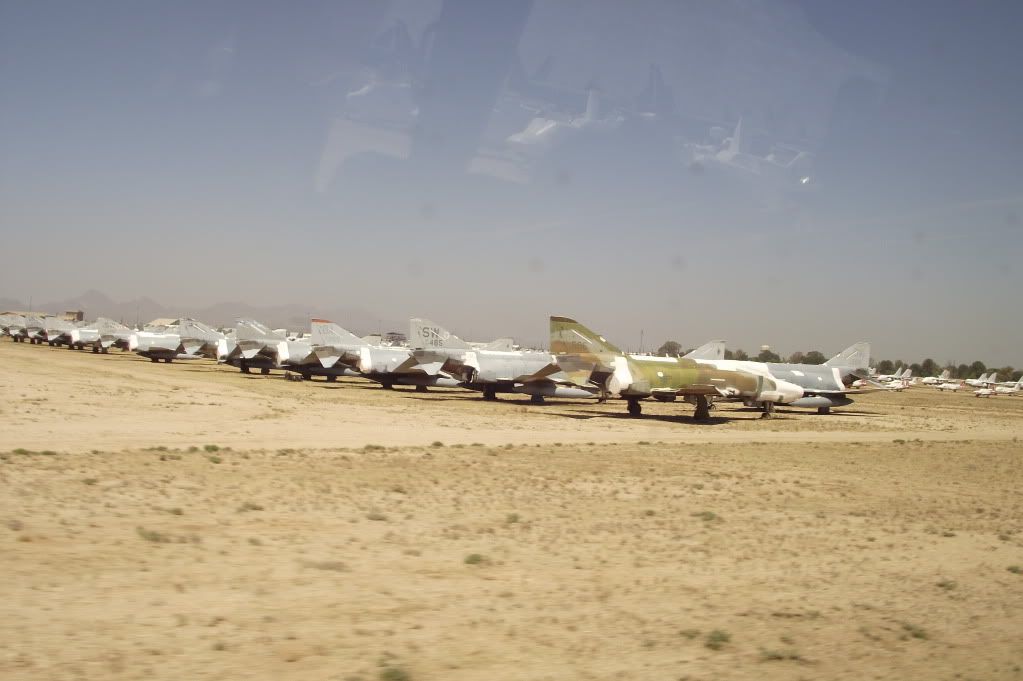 |
| Row after row of old F4 Phantoms--The US doesn't use them anymore, but some of our allies do, so we keep them around for spares and replacement aircraft. Spare part sales help the facility return $11 for every $1 spent. |
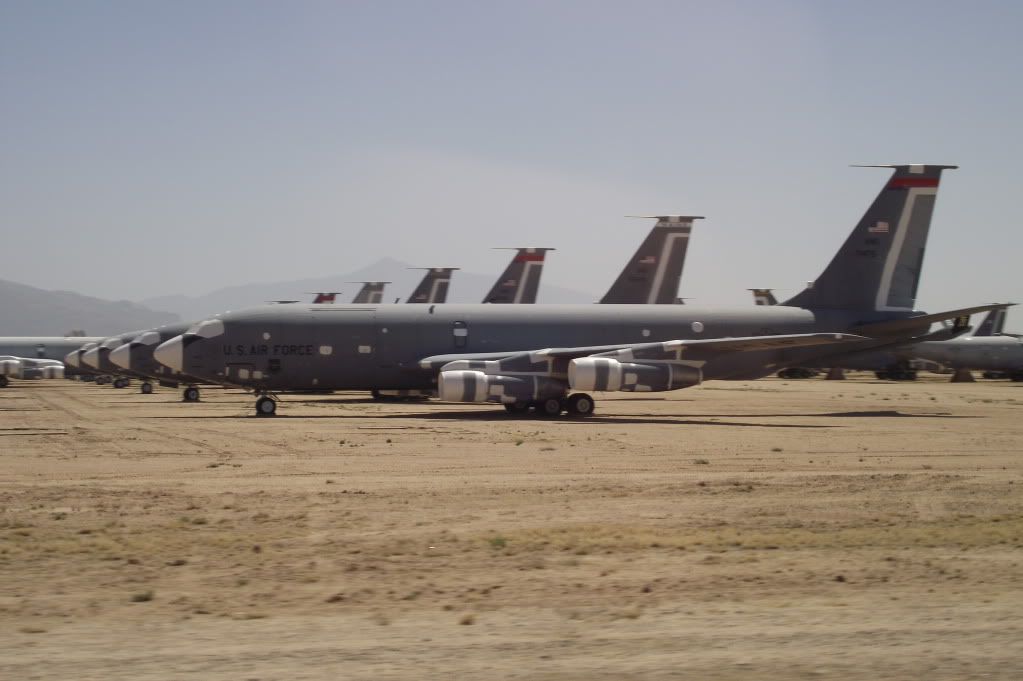 |
| Note the white sealant around the cockpit windows and other openings. This is to control the temperature inside the plane--keeping it only about 10-15 degrees above the ambient 95 degree weather, as opposed to jumping into ranges like 200 degrees that could hurt the plane. It gave the planes a strange air--I'd never seen anything like it before. |
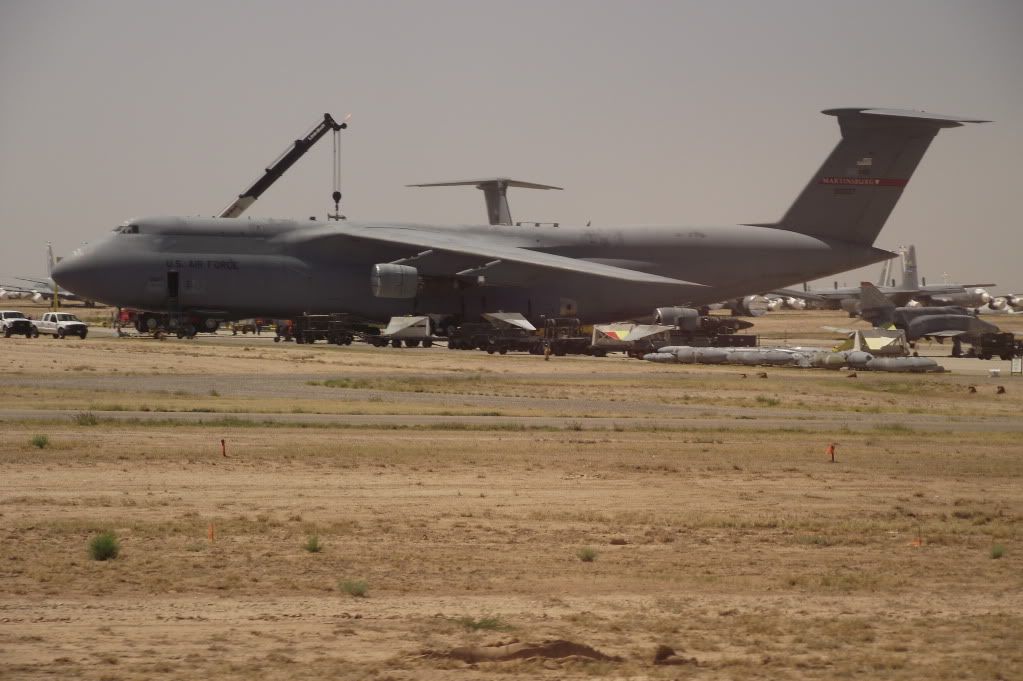 |
| An enormous C-5 Galaxy transport was being processed while we were there--they were removing the engines for storage, and getting the rest of the plane ready for mothballing alongside 18 others being retired as the new C-17 come into service. Incredible to see the scale of these things, even more to see ten or twelve parked under the desert sun. |
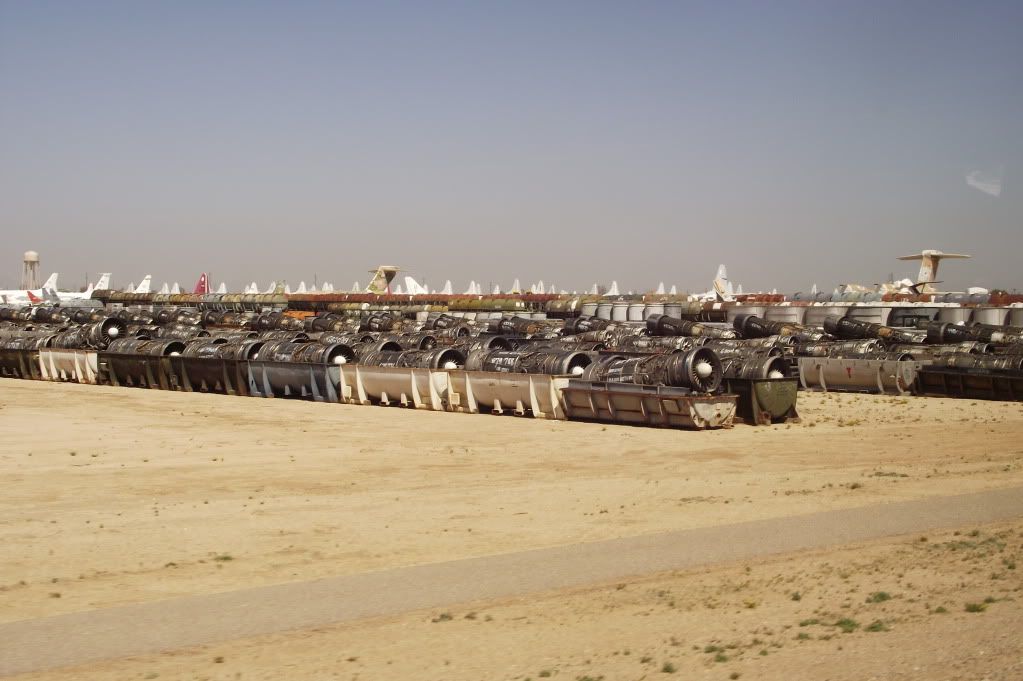 |
| Some engines being stored in canisters. Made me and several other Star Wars nerds think of the pod-racing scenes from Star Wars: A Phantom Menace. Again, very strange sights. |
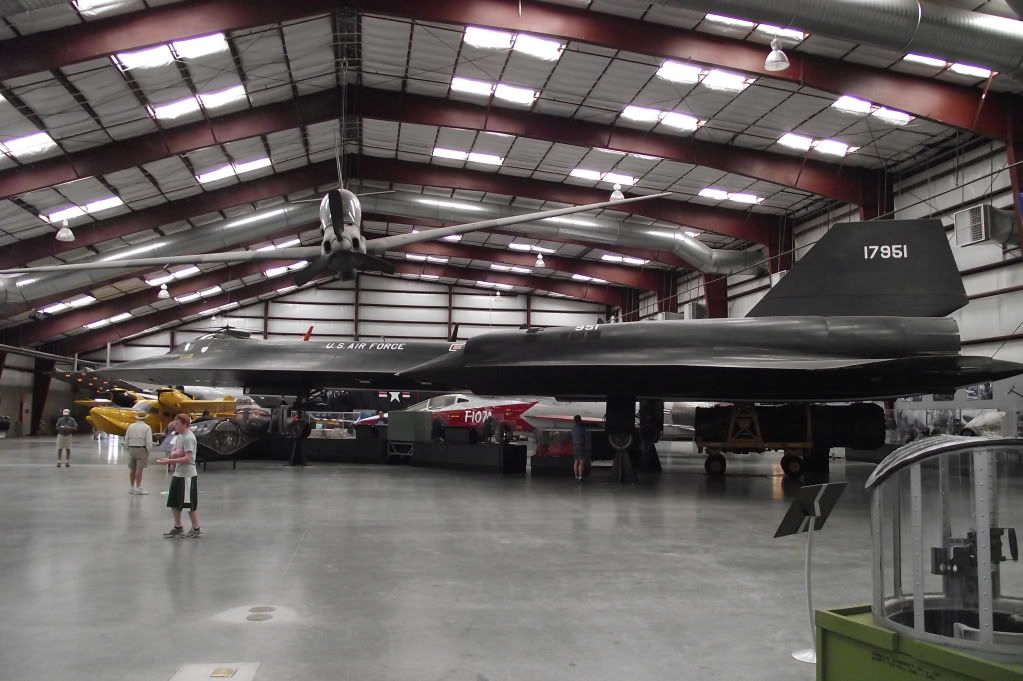 |
| The main hangars were better arranged and lit than the USAF Museum, and though the overall variety wasn't as great, there were some great one-off airplanes. |
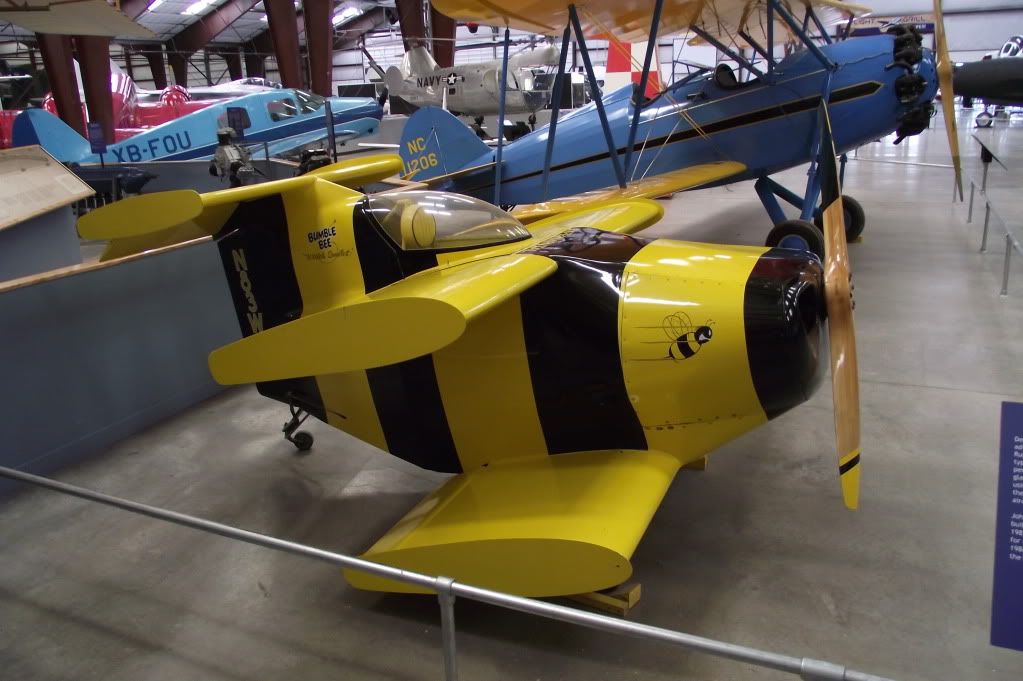 |
| One of these was the Bumblebee II: A biplane specifically designed for attaining the world record for smallest manned airplane. It had a wingspan barely longer than my arm span, and an incredibly low aspect ratio--maybe 2 or 3? Dr. Altman made some comments about the layout of the wings relative to one another, but I can't recall his specific critique. It was funny to think that this thing didn't have much more wing area than our AIAA plane from last year. |
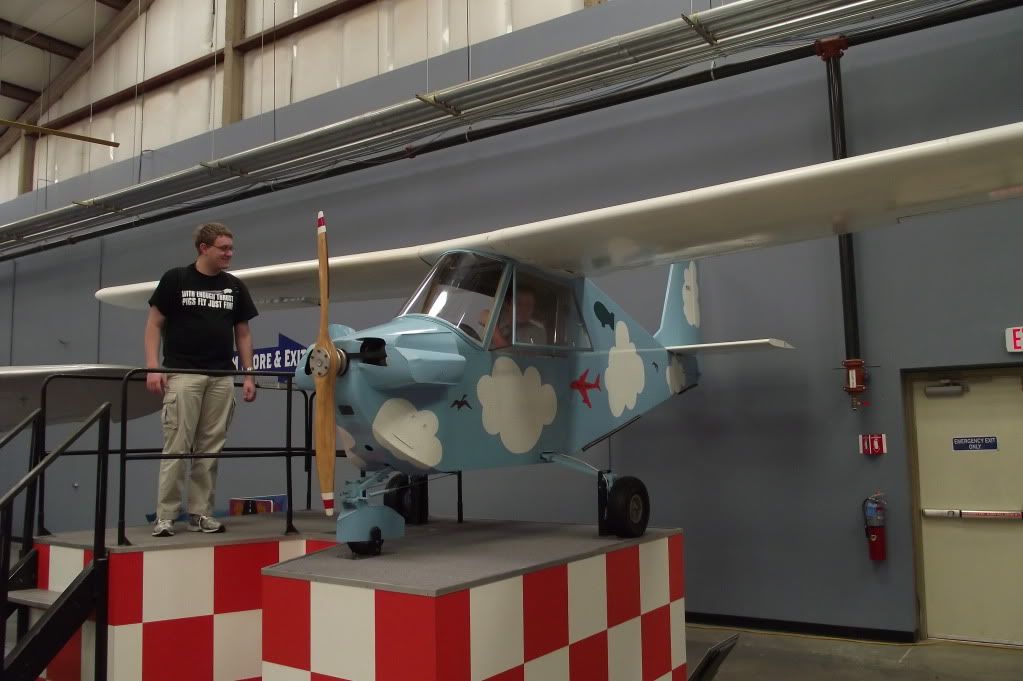 |
| Andrew McClinton (one of two or three members on the team with pilot's licenses) brushes up on his control theory while I look on. This was perhaps not for our precise age group, but Andrew had fun messing with the mobile control surfaces. |
It was nice to have a chance to walk around and talk to the other teams, though. Several people I'd met previously this year or last year were there, including the OSU DBF team (their first year, and they did pretty well with it) and Wyatt and the other USC team members, who shared a hotel with us last year and this year were a lot of help with issues I'm going to be talking about in a bit. Evening activities included a trip to a very good steakhouse, and heading to sleep early to catch up some from the time changes.
Saturday started off with us finally getting a chance to tech, as some other teams were preparing for their second or third flights. Things largely went well--except for the failsafe system. Competition rules require a system on the aircraft's receiver such that if the plane stops receiving instructions from the controller on the ground, it will automatically enter a death spiral. The organizers do this in the name of the safety of the crowd, but it's rather annoying for those teams that see it trip--it means a simple radio issue can send your plane crashing down in a way that may be basically unrecoverable. Failsafes are common in radio-controlled aircraft, but it's more normal to see them set to have the plane slow down to about 50% speed and hold the last command--stay turning, or continue to fly straight or whatever, partly for the same reason: some competition R/C planes can cost upwards of $1000, and pilots don't want to lose them because of radio issues. Thus, most modern receivers and transmitters are actually incapable of performing the particular failsafe required by competition. This included, as it turned out, our receiver--we couldn't get our rudder to deflect properly for the death spiral. Thus, in order to pass tech, we had to spend almost three hours messing around with our control system, and eventually switching to a totally different transmitter/receiver combination, which was lent to us by USC.
Finally, though, we did pass tech inspection, just as they were about to call our number in the flight order's second rotation. We didn't want to miss another chance, so we began packing up the plane, and hurrying to get to the other side of the judging section just as they called our number. Despite calling to them from only a few feet away, the judge proceeded to call no fewer than four more teams--skipping us for another cycle. Combined with the failsafe issue, tempers started to flare a bit. We managed one flight attempt later in the afternoon, on the next cycle, but a poor hand launch didn't give the plane the right velocity for flight, and it acquainted itself with the ground only a few feet away. Though undamaged and still largely ready-to-fly, the impact broke the propeller and repairs were not allowed, so we'd have to wait another cycle to get into the air. We spent the afternoon using a scale and some statics to verify our static thrust, confirming that it was a launch error and not an issue with the climate difference between Dayton and Tucson, then did some more work on the aerodynamics of flying disc-shaped objects. It looked like we might get one more chance to fly Saturday, but we lost out at the last minute. We'd be close to first Sunday, but...seeing two days down, and not a single successful flight brought morale down a lot, especially since we now had only three remaining flight attempts. To fly all three missions, everything had to go right.
By the end of the day, we were all pretty drained and worn down, but this was altered significantly when some friends of Dr. Altman's family invited us to their place up in the hills. The night sky was amazing--the stars and moon were incredibly clear, and the pool and hot tub were a nice change of pace from the heat. For me, the highlight was when we saw a bright object travel across the sky, from the south-west to the north-east. Dr. Altman said it looked like the trajectory for something in orbit, and Alex Hunton (one of the team's new members, and the guy who took so many of the pictures I've been using through here) wondered if it might be the ISS. I pulled up Heaven's Above on my Pre, and the ground track confirmed it; by complete chance, I'd finally seen what I've been trying for months to see, and the sky couldn't have been better for it. For me, this felt like a good sign for the rest of competition, and for the rest of the team, if the space station didn't do it, the excellent food and the pool helped settle some tempers and sooth frustrations.
Sunday felt a bit strange--because they started flights on Friday instead of Saturday morning, the competition was significantly ahead of previous years. Several teams had already completed all their flights, and others had crashed beyond recovery, so the tent felt oddly empty, and the flight rotation was moving through so quickly that the order began to basically fall apart by afternoon and teams were allowed to fly as soon as they were ready instead of waiting on a rotation. For us, though, the day started off very well--we got to the site right at the start, and moved directly into the assembly area to fly. Leslie Sollman once again assembled well within time, even with time to test the control surfaces, then after waiting behind a few other teams at the flight line, Josh took another try at hand-launching for competition. His throw was better, but it still took a demonstration of supreme skill and confidence on Chris' part to recover when the plane tumbled into a roll off the throw, ending up about 15 feet off the ground and rolled so much that one wing was pointed right at the ground. 4 laps and about 3 minutes later, Chris set the plane down in a perfect belly-landing, and we had a score on the board, moving us from 67th place to 43rd. Considering last year we never managed to get on the board, we counted this as a good start, and stopped for some team pictures.
 |
| Left to right: Josh, Cody, Dr. Altman, Me, Kramer, Leslie, James, and Alex Front Row: Andrew and Steven (the plane) |
 |
| No, Andrew, your other right. |
So, once again, we left the flight line without flying, bearing a plane almost completely flyable...except for one change that would take all of ten seconds to fix. However, this was around the time they switched to "come when you're ready" instead of a roster, and so we decided to take a breath, check the plane once more for any other issues, get good and ready, then go up for our fourth attempt. The videos of assembly and the flight for this one are actually posted, so I'll let them speak for themselves.
 |
| Leslie Going to Work |
 |
| Kramer's Hand Launch and the Flight |
It's getting to within a week of the end of school, and there's a lot of this kind of wrap-up going on. Classes, DBF, finalizing summer plans, and all kinds of other things. Still, if there's one thing I've learned, it's that as every challenge ends, there's always a new one waiting. Part of me can't wait for school to be over, part of me wishes it wouldn't end for another month, and part of me just can't wait for it to be next year already so we could do this all over again. Anyway, so that's the end of this for another year. More space posts to come as I have the time.
Sunday, April 10, 2011
Engineering in Progress goes "Crunch"
So, I go on vacation for the weekend, and what does the team decide to do? Play catch with the plane. And fail on the "catch" part.
Thankfully, this is the V1 prototype (a.k.a. The Hulk), and there is a good reason for all this, so I don't need to yell at someone at the meeting tomorrow, which is nice because I don't really like doing yelling. The idea was to prepare for the testing today, since the weather was poor yesterday. To do this, they loaded the plane to an 8.5 pound total weight (2 pounds heavier than any previous attempt) and practiced hand-launching it. Luckily, catching the plane is not required at competition.
Today saw six hours at the field, and about 10 flights to apply payload testing to the competition aircraft and verify the stuff needed for the Pre-Tech Certification paperwork. I'll put edit some links and more detail in as I know them. Regardless, it feels like we're really ready for competition, and I'm really looking forward to getting to talk to everyone at Tucson. Competition was great last year; getting to hear others talking about solving the same problems our team did in different ways and with subtly different assumptions leading to radically different solutions was very enriching, and I think it helped with our process this year. This year, having been much more involved with the process of design and having the experience of building three different airframes, I think it'll be all the more interesting.
Actually, I know it will for me, I had a taste of it last weekend. At the AIAA Region III Student Conference, I got to talk to some members of The Ohio State team. This is their first year, and they sounded a lot like they were in the same position we were last year in terms of team-building, but their plane still was interesting enough in its approach that I found discussing their approach and comparing ours to be very enriching.
 |
| Click text for video |
Thankfully, this is the V1 prototype (a.k.a. The Hulk), and there is a good reason for all this, so I don't need to yell at someone at the meeting tomorrow, which is nice because I don't really like doing yelling. The idea was to prepare for the testing today, since the weather was poor yesterday. To do this, they loaded the plane to an 8.5 pound total weight (2 pounds heavier than any previous attempt) and practiced hand-launching it. Luckily, catching the plane is not required at competition.
Today saw six hours at the field, and about 10 flights to apply payload testing to the competition aircraft and verify the stuff needed for the Pre-Tech Certification paperwork. I'll put edit some links and more detail in as I know them. Regardless, it feels like we're really ready for competition, and I'm really looking forward to getting to talk to everyone at Tucson. Competition was great last year; getting to hear others talking about solving the same problems our team did in different ways and with subtly different assumptions leading to radically different solutions was very enriching, and I think it helped with our process this year. This year, having been much more involved with the process of design and having the experience of building three different airframes, I think it'll be all the more interesting.
Actually, I know it will for me, I had a taste of it last weekend. At the AIAA Region III Student Conference, I got to talk to some members of The Ohio State team. This is their first year, and they sounded a lot like they were in the same position we were last year in terms of team-building, but their plane still was interesting enough in its approach that I found discussing their approach and comparing ours to be very enriching.
Tuesday, April 5, 2011
Big Rockets and a New Launch Site (For Real)
So, the SpaceX announcement of their new "something big" happened earlier today. It's not quite what I joked about yesterday, but it's still very impressive. In many respects, it's much of what was predicted: Falcon Heavy official announcement, a new launch site at Vandenberg capable of launching the Heavy, and modifications to their launch site at Cape Canaveral to be able to launch the Heavy there too (the current integration building is not large enough for the three-core Heavy). However, as always, the devil is in the details, and in this case, those details are perhaps even more impressive.


Monday, April 4, 2011
SpaceX Announcement Leak: Big Rockets and a new Launch Site
EDIT: The below was posted as my April Fool's joke, a little late. If you're arriving from Google or elsewhere and were hoping for serious updates on the SpaceX Falcon Heavy announcement, try this post instead for my serious reaction to the actual news.
So, there's been a lot of chatter the past week or so about the teaser video SpaceX put out, linked below.
That some element of the Falcon 9 Heavy (now apparently renamed Falcon Heavy, possibly because of the planned switch to a single Merlin 2 engine per core instead of 9 Merlin 1Cs sometime in the future) was going to be announced, and that a new launch site might be involved was also not unexpected (plans for a site at Vandenberg capable of processing the Falcon Heavy have been filed with EPA already, several months ago). However, new leaks (I can't cite sources yet) indicate that this may not be the entire extent of the "something big" coming!
So, there's been a lot of chatter the past week or so about the teaser video SpaceX put out, linked below.
That some element of the Falcon 9 Heavy (now apparently renamed Falcon Heavy, possibly because of the planned switch to a single Merlin 2 engine per core instead of 9 Merlin 1Cs sometime in the future) was going to be announced, and that a new launch site might be involved was also not unexpected (plans for a site at Vandenberg capable of processing the Falcon Heavy have been filed with EPA already, several months ago). However, new leaks (I can't cite sources yet) indicate that this may not be the entire extent of the "something big" coming!
Subscribe to:
Posts (Atom)